RORATE CÆLI

+ TEMPUS per annum POST PENTECOSTEN +

Saturday, July 05, 2008

Indulgences during Pope's visit to Australia

For Catholics in Australia and elsewhere (Decree in English).

Labels:

Friday, July 04, 2008

All hail the Holy Constable!


Of the great men and women whose miraculous intercession, martyrdom, or heroic virtue were recognized by Pope Benedict XVI yesterday, the most well-known is certainly Blessed Damien of Molokai, the magnificent missionary whose life of sacrifice, of slow martyrdom for the cause of the sick, is admired throughout the world.

Yet, in an age of so many disgraceful individuals involved in public life, the life of the Holy Constable of Portugal, Blessed Nuno Alvares Pereira (1360-1431), is perhaps the most surprising of them. One of the greatest statesmen and military leaders in the history of the Iberian Peninsula, he was always a most faithful son of the Church. After becoming a widower, and despite having all the fortune, power, and gratitude of his nation at his disposal, Blessed (soon to be Saint) Nuno became a Carmelite lay brother in a monastery whose foundation he himself had helped.

A great warrior, a loyal protector of his nation, its Sovereigns, and its independence, a good father and husband, a generous benefactor, a humble monk; at all times, an unwavering Son of the Holy Catholic Church: a full and complete hero for our empty and defective age.

Thursday, July 03, 2008

Reform in the New Mass
Vernacular celebrations with Latin Prex?

Ignazio Ingrao, religious correspondent for Italian weekly Panorama, reports the following:

BENEDICT CHANGES THE MASS - THE STUDY OF THE NEW LITURGY ASSIGNED TO THE CONGREGATION FOR WORSHIP

The rite of the Mass [Rorate: i.e. the Mass of Paul VI] could change. According to some indiscretions, Benedict XVI has charged the Congregation for Divine Worship to study some modifications in the liturgy. In particular, the Pope is said to have the intention to restore Latin for the formula for the Eucharistic consecration within the Mass in the "vernacular language", i.e. the one celebrated in the different national languages. The same could happen to the formulae of Baptism, Confirmation, Confession and of the other sacraments. In addition, the exchange of peace among the faithful during the Mass, which today takes place prior to the distribution of the Eucharist, could be anticipated (as in the Ambrosian rite) to the offertory so as not to disturb the recollection that precedes Communion.

These would be changes which would be added to the changes in the liturgy and regarding sacred vestments which the Pope, together with his Master of Ceremonies, Monsignor Guido Marini, has made in recent months, to recover ancient traditions: the restoration of the crucifix at the center of the altar, the distribution of Communion to the faithful in the mouth while kneeling, the recovery of the pastoral staff of Pius IX (the ferula), the changing of the style of pallium (the strip of white wool with red crosses worn by the Pope), the restoration of the papal throne used in the Consistory and the celebration of Mass with the back to the assembly, as happened in January in the Sistine Chapel.
Many of the Council Fathers believed that this would be the order of the reformed Mass: most parts in the vernacular and the (one and only) Roman Canon kept in Latin. In fact, the Constitution Sacrosanctum Concilium did not seem to foresee the use of the vernacular during the Canon (cf. SC 36, 2; 54; cf. Inter Oecumenici, 57-59). [Translation by Gregor Kollmorgen for The New Liturgical Movement./Tip: Papa Ratzinger blog.]

Wednesday, July 02, 2008

Castrillón satisfied with SSPX answer
SSPX will give heed to the five points

From the blog of Andrea Tornielli (Vatican correspondent for Il Giornale):

I have learned from secure sources that, contrary to what has appeared in certain articles, the response of the Fraternity [of Saint Pius X - FSSPX/SSPX] to the letter of Cardinal Castrillón has not in fact been negative. The Cardinal is satisfied with it, has responded to Fellay, and has promptly delivered the letter of the Fraternity to Benedict XVI. After the deadline of the end of June, the Lefebvrists [sic] ask for time but - it seems - they will aim to respect the five points.

Labels:

20 years ago today, at noon, Rome time...

ECCLESIA DEI adflicta illegitimam cognovit episcopalem ordinationem ab Archiepiscopo Marcello Lefebvre die tricesimo mensis Iunii collatam, unde ad nihilum sunt omnes conatus redacti horum superiorum annorum ut nempe in tuto collocaretur ipsa cum Ecclesia communio Fraternitatis Sacerdotalis a Sancto Pio Decimo quam idem condidit Reverendissimus Dominus Lefebvre. ... (Latin/English)

More in the upcoming Part IV of our special series on 1988.

Tuesday, July 01, 2008

Important: Transalpine Redemptorists on the move
Now regularized


Very relevant news made public by the Transalpine Redemptorists, children of Saint Alphonsus Maria Liguori and helped throughout their history by Archbishop Marcel Lefebvre and the Priestly Fraternity of Saint Pius X (FSSPX / SSPX):

1 July, 2008
Feast of the Precious Blood

My dear friends,

I am happy to inform you that last June 18th, before Cardinal Castrillon and the members of the Pontifical Commission Ecclesia Dei in Rome, I humbly petitioned the Holy See on my own behalf and on behalf of the monastery council for our priestly suspensions to be lifted.

On June 26th I received word that the Holy See had granted our petition. All canonical censures have been lifted.

Our community now truly rejoices in undisputed and peaceful posession of Communion with the Holy See because our priests are now in canonical good standing.

We are very grateful to our Holy Father Pope Benedict XVI for issuing, last July, the Motu Proprio Summorum Pontificum which called us to come into undisputed and peaceful Communion with him.

Now we have that undisputed communion! It is a pearl of great price; a treasure hidden in the field; a sweetness that cannot be imagined by those who have not tasted it or who have not known it, now for many years. Its value cannot be fully expressed in earthly language and therefore we hope that all traditional priests who have not yet done so, will answer Pope Benedict's call to enjoy the grace of peaceful and undisputed communion with him. Believe us, the price to pay is nothing; even all the angry voices that have shouted against us and calumniated us are as nothing when weighed in the scales against undisputed communion with the Vicar of Christ; others have died for it; what are raucous voices?

We publicly thank all those souls who have prayed for us over the last months; some of you have truly stormed heaven for us. You have kept us afloat. We are deeply grateful. Especially we thank that priest who was unknown to us, until June 16th when he wrote in fraternal support. Where did he come from? Why us? But he told us of the number of Masses, Offices, prayers and sacrifices he had personally said for us; he had also enlisted the prayers of contemplatives and Third Order societies and had a great number of people fervently praying for us with an abundance of prayers. We were amazed! Thank you Father! Thank you also to that brave person who, so kindly wrote to us to say that if he said any more prayers for us he would be floating! What wonderful people! Thank you!

Looking to the future, the next stage will be to have our community canonically erected. So please, dear friends, keep praying for us, there will be many crosses to bear; but they will be yokes sweetened by the grace of these last days.

We assure you all of our very best wishes.
Your devoted servant,

Fr. Michael Mary, C.SS.R.
Vicar General

Updated
SSPX asks for removal of excommunications
Official SSPX note. I.MEDIA. APIC


[Update-1600 GMT] The official news agency of the Priestly Fraternity of Saint Pius X (FSSPX / SSPX), DICI, has published the first official communiqué of the Fraternity on current events:

On the matter of the ultimatum of Cardinal Castrillón Hoyos

On June 4, 2008, at the request of Cardinal Darío Castrillón Hoyos, president of the Pontifical Commission Ecclesia Dei, the Superior General of the Fraternity of Saint Pius X, Bishop Bernard Fellay, went to Rome, along with the 2nd Assistant General, Father Alain-Marc Nély.

In the course of the meeting, a memorandum, in the form of an ultimatum, was given to him, an answer being demanded by the end of the month of June. On June 23, contrarily to custom, Italian daily Il Giornale revealed the existence of this ultimatum and published its content, on the next day, in its electronic edition. The information was picked up in the following days by the entire international press. Therefore, in addition to the urgency of the ultimatum, there was media pressure.

The document of Cardinal Castrillón Hoyos included five demands: besides a positive answer asked for before the end of June, the Fraternity of Saint Pius X, in the person of its Superior General, should commit (1) to "a response proportionate to the generosity of the Pope"; (2) "to avoid every public intervention which does not respect the person of the Holy Father and which may be negative to ecclesial charity"; (3) to "avoid the claim to a Magisterium superior to the Holy Father and to not propose the Fraternity in contraposition to the Church"; (4) to "display the will to act honestly in full ecclesial charity and in respect for the authority of the Vicar of Christ".

It should be noticed that the very generic, not to say vague, character of the proposed demands contrasts remarkably with the urgency of an ultimatum. These conditions seem to aim at the achievement of a climate favorable to an ulterior dialogue, rather than being precise commitments on exact points. The Fraternity of Saint Pius X wishes that this dialogue be situated at a doctrinal level and take into consideration all questions which, if evaded, would run the risk of turning obsolete a canonical position established in haste. It considers that the prior withdrawal of the decrees of excommunication of 1988 would favor the serenity of such dialogue.

The Fraternity of Saint Pius X does not claim to exercise a Magisterium superior to that of the Holy Father, neither intends to oppose itself to the Church. Following its founder, it intends to transmit that which it has received, that is, "that which has been believed always, everywhere, and by all". It makes its own the profession of faith which Archbishop Marcel Lefebvre addressed to Paul VI on September 24, 1975: "It is to His Vicar whom Jesus Christ entrusted the mission to confirm his brothers in the faith and whom He demands to watch so that every bishop will faithfully guard the deposit, according to the words of Saint Paul to Timothy."

It is in this sense that Monsignor Fellay responded to the ultimatum in a letter to Pope Benedict XVI, on Thursday, June 26, 2008. Cardinal Castrillón Hoyos simply noticed the reception of this response on the following day.

Until further information is available, no comment will be made.

Father Alain Lorans
[Spokesman]
(Permanent link for the French text.)

______________________________________

[Update-1605 GMT] Swiss news agency APIC adds the following: " 'The letter is on the Pope's bureau,' it [the Pontifical Commisson Ecclesia Dei] has indicated, noticing that 'discretion' should be kept in this affair."

______________________________________

[Original text:] Agence France-Presse (AFP) publishes today the information that the Rome-based French religious news agency I.MEDIA reports that the Priestly Fraternity of Saint Pius X (FSSPX / SSPX) has asked the Holy See to lift the excommunications:

The Priestly Fraternity of Saint Pius X has asked the Vatican to lift the excommunications pronounced against it, an Integrist [sic] organization, to display its will to dialogue, according to religious news agency I.Media.

The Superior of the Fraternity, Bishop Bernard Fellay, sent Pope Bendict XVI a letter responding to the conditions posed by the Vatican to a reintegration of this organization, founded by schismatic [sic] bishop Marcel Lefebvre, the agency notes.

According to an internal note of the Fraternity mentioned by I.Media, Bishop Fellay asks that the dialogue "be placed at a doctrinal level" and that he may avoid every hastiness. He underlines that "prior withdrawal of the excommunication of 1988 would favor the serenity of such a dialogue".
...
"These conditions seem to aim the achievement of a climate favorable to an ulterior dialogue rather than precise commitments on exact points," the Priestly Fraternity considers in its note.
It seems step one of the "One-Two-Three Strategy" is about to be completely accomplished.

Labels:

Monday, June 30, 2008

Bishop DiLorenzo knew of abortion plan
Told 'there was nothing he could do'


The Roman Catholic bishop of Richmond was told that a diocesan charity planned to help a teenage foster child get an abortion in January and did not try to prevent the procedure.
...

Bill Etherington, an attorney for the diocese and CCR, said Bishop DiLorenzo was given bad information about whether the abortion could be prevented, but didn't elaborate as to how.

"He was told it could not be stopped," Mr. Etherington said. "It was erroneous information. He didn't have to sign off on it. He was not personally involved."


We are strengthened in our Editorial position: Bishop DiLorenzo must resign.
Tip: reader.

Update (1500 GMT): The Bishop "apologizes" for the "loss of life" (no mention of the word abortion here...). If the Bishop bears no responsibility for the abortion, he has nothing for which to apologize; if he bears any responsibility for the abortion, an apology is clearly not enough: he must resign.

Warning...

Hervé Yannou, the Rome correspondent for the French national daily Le Figaro, reports the following today:

La Fraternité Saint-Pie X rejette les propositions du Pape et affirme qu'elle n'acceptera jamais Vatican II.

It is no. Bishop Bernard Fellay, Superior of the schismatic [sic] Fraternity of Saint Pius X, and leader of the Integrist [sic] Catholics, has rejected the hand extended by the Vatican last week to reunite with Church ranks. While the official response has not yet been published [sic], there is no doubt: Archbishop Marcel Lefebvre's faithful do not wish, twenty years after their excommunication, [to profit from] the historic occasion which Benedict XVI has offered them to defitively reconcile with the Holy See.
RORATE note. This is repulsive: tendentious punditry dressed up as a news report. It may well be that the content of the response sent by Bishop Fellay last Thursday is absolutely negative regarding the conditions proposed by Cardinal Castrillón Hoyos, but M. Yannou has certainly based his "report" solely on recycled news, such as the telephone interview granted by the FSSPX/SSPX spokesman, Father Lorans, to some news agencies and to the interview granted by Bishop Richard Williamson to Petrus. Not a single word of the letter itself is to be found in Yannou's article.

Some repetition of Yannou's opinion piece is likely to be seen in news dispatches and large newspapers throughout the day, as was probably his intent: not to report but to influence. Since this poor weblog has always had as its main goal, from its first news translation, to help those who read it to discriminate what seems to be true reporting (or, at least, credible rumors) from biased distortions, we warn our readers against the distorters during these very delicate days. (Tip: Le Forum Catholique)

[Update: On the other hand, the most trustworthy French daily, Présent, reports the following today: "What we may accurately say at the current hour is that Bishop Fellay has certainly answered, in the established time, the cardinalatial letter. And that some underline that he would have been given a positive notice of receipt..."]

Labels:

Sunday, June 29, 2008

20 years on: Reliving the Events of 1988
Part III: The Archbishop rejects the Protocol
May 5, 1988 - June 29, 1988


Part I: July 1987 - February 1988
Part II: March 1988 - May 5, 1988

Archbishop Marcel Lefebvre, founder of the Priestly Fraternity of Saint Pius X (FSSPX / SSPX), received in the Fraternity House at Albano Laziale (near Castel Gandolfo) the final text of the Protocol which was sent to him by Cardinal Ratzinger. It was 4:30 PM as the old bishop signed the text. His most extensive biographer, Bishop Tissier de Mallerais (one of the chief negotiators in that afternoon and who would be consecrated on June 30), described the scene:

His face perfectly expresse[d] the mixed feelings which gripped him: "real satisfaction," as he would write to Ratzinger, and silent mistrust which he spoke of to the sisters in the Cenacolo convent [of the Discepole del Cenacolo, in Velletri, near Albano] at 3 PM: "If Don Putti [Fr. Francesco-Maria Putti, a Traditional Roman priest and spiritual son of Padre Pio, who guided and formed the sisters until his death in 1984] were here, what would he say? 'Your Grace, where are you going? What are you doing?' "
The Archbishop did not sleep during what must have felt like one of the longest nights of his life. The following morning, after Mass and Prime, he sent a letter to Cardinal with an ultimatum of his own: the deadline of June 30, 1988, mentioned in one of his previous letters exchanged in the negotiations was still valid. The text of that letter was:

Yesterday it was with real satisfaction that I put my signature on the Protocol drafted during the preceding days. However, you yourself have witnessed my deep disappointment upon the reading of the letter, which you gave me, bringing the Holy Father's answer concerning the episcopal consecrations.

Practically, to postpone the episcopal consecrations to a later undetermined date would be the fourth time that it would have been postponed. The date of June 30 was clearly indicated in my previous letters as the latest possible.

I have already given you a file concerning the candidates. There are still two months to make the mandate.

Given the particular circumstances of this proposal, the Holy Father can very well shorten the procedure so that the mandate be communicated to us around mid-June.

In case the answer will be negative, I would find myself in conscience obliged to proceed with the consecrations, relying upon the agreement given by the Holy See in the Protocol for the consecration of one bishop, member of the Society.

The reticence expressed on the subject of the episcopal consecration of a member of the Society, either by writing or by word of mouth, gives me reason to fear delays. Everything is now prepared for the ceremony of June 30: hotel reservations, transportation, rental of a huge tent to house the ceremony.

The disappointment of our priests and faithful would be extreme. All of them hope that this consecration will be realized with the agreement of the Holy See; but being already disappointed by previous delays they will not understand that I would accept a further delay. They are aware and desirous above all of having truly Catholic bishops transmitting the true Faith to them, and communicating to them in a way that is certain the graces of salvation to which they aspire for themselves and for their children.

In the hope that this request shall not be an insurmountable obstacle to the reconciliation in process, please, Eminence, accept my respectful and fraternal sentiments in Christo et Maria.

+Marcel Lefebvre
Upon receiving the letter, Cardinal Ratzinger immediately canceled the publication of the communiqué which had been prepared - which explains the scarce report by the secular media of what was taking place. Ratzinger first wrote a note to Lefebvre, asking him to "reconsider his position".

I have attentively read the letter, which you just addressed, to me, in which you tell me your intentions concerning the episcopal consecration of a member of the Society on June 30th next.

Since these intentions are in sharp contrast with what has been accepted during our dialogue on May 4th, and which has been signed in the Protocol yesterday, I wish to inform you that the release of the press communiqué has to be deferred.

I earnestly wish that you reconsider your position in conformity with the results of the dialogue, so that the communiqué may be released.

In this hope, please, Excellency

Joseph Cardinal Ratzinger
In the evening of May 6, he took Lefebvre's letter to Pope John Paul in the Apostolic Palace.

The Archbishop returned promptly to Ecône and, on May 10, assembled most of his priests in Europe at Saint-Nicolas du Chardonnet (Paris), and explained the situation as it stood then:

Fr. [Emmanuel] du Chalard brought [Cardinal Ratzinger's] letter to me at Ecône on Sunday morning. I said to him, "Tell the Secretary of the Cardinal that for me the whole thing is finished. I am not changing the date of June 30th. It is the final date. I feel my strength diminishing. I even have a difficulty in traveling by car. I think it would be to put in danger the continuation of the Society and the seminaries if I do not perform these consecrations." I think they will agree to that date. They are too anxious for this reconciliation.
Tissier de Mallerais describes the frantic events of late May 1988:

On May 17, Ratzinger wrote to Lefebvre: a letter to the Holy Father "humbly requesting" reconciliation and forgiveness would be welcome: the request for a bishop from the Fraternity could be raised "without demanding any date". ... Not only did [Lefebvre] underline that June 30 was for him the deadline to assure "his succession", but he also considered it necessary to have several bishops. On May 23, he left for Rome. ...

In Rome, on May 24, the Archbishop gave the Cardinal his final request: "Before June 1, let me know the Holy See's intentions as regards the consecration of three bishops planned for June 30 ... . As I wrote to the Pope, one bishop alone will not be enough for the apostolate." ... John Paul II replied through the Cardinal on May 30: ... as for the bishops, "the Holy Father is ready to appoint a bishop from the Fraternity ... such that the consecration could take place before August 15."
Contacted, the Superior General of the Fraternity, Father Franz Schmidberger, who was in America, came to Rome. At the same day, May 30, at the Fraternity priory of Notre Dame du Pointet (at Broût-Vernet, near Vichy), Lefebvre assembled representatives of the Fraternity and of all friendly communities which would be affected by his decision, including Dom Gérard Calvet of Le Barroux and several sisters. Many of those present favored the agreement, but there seemed to be a majority against it. On the Feast of Corpus Christi, June 2, Lefebvre wrote his final letter to the Pope:

June 2, 1988

Most Holy Father,

The conversations and meetings with Cardinal Ratzinger and his collaborators, although they took place in an atmosphere of courtesy and charity, persuaded us that the moment for a frank and efficacious collaboration between us has not yet arrived.

For indeed, if the ordinary Christian is authorized to ask the competent Church authorities to preserve for him the Faith of his Baptism, how much more true is that for priests, religious, and nuns?

It is to keep the Faith of our Baptism intact that we have had to resist the spirit of Vatican II and the reforms inspired by it.

The false ecumenism, which is at the origin of all the Council's innovations in the liturgy, in the new relationship between the Church and the world, in the conception of the Church itself, is leading the Church to its ruin and Catholics to apostasy.

Being radically opposed to this destruction of our Faith and determined to remain within the traditional doctrine and discipline of the Church, especially as far as the formation of priests and the religious life is concerned, we find ourselves in the absolute necessity of having ecclesiastical authorities who embrace our concerns and will help us to protect ourselves against the spirit of Vatican II and the spirit of Assisi.

That is why we are asking for several bishops chosen from within Catholic Tradition, and for a majority of the members on the projected Roman Commission for Tradition, in order to protect ourselves against all compromise.

Given the refusal to consider our requests, and it being evident that the purpose of this reconciliation is not at all the same in the eyes of the Holy See as it is in our eyes, we believe it preferable to wait for times more propitious for the return of Rome to Tradition. That is why we shall give ourselves the means to carry on the work which Providence has entrusted to us, being assured by His Eminence Cardinal Ratzinger's letter of May 30th that the episcopal consecration is not contrary to the will of the Holy See, since it was granted for August 15th.

We shall continue to pray for modern Rome, infested with Modernism, to become once more Catholic Rome and to rediscover its two-thousand-year-old tradition. Then the problem of our reconciliation will have no further reason to exist and the Church will experience a new youth.

Be so good, Most Holy Father, as to accept the expression of my most respectful and filially devoted sentiments in Jesus and Mary.

+ Marcel Lefebvre
On June 9, John Paul wrote to him and called his plan "a schismatic act". The Cardinal's secretary met with the Archbishop in Ecône the next day: the long meeting was fruitless. On June 13, Lefebvre had settled on the names of the four priests he would consecrate on June 30: Bernard Fellay (General Bursar of the Fraternity), Alfonso de Galarreta (Superior of the South American District), Bernard Tissier de Mallerais (Secretary General of the Fraternity and who had favored the agreement at the Notre-Dame du Pointet meeting), and Richard Williamson (Rector of the North American Seminary).

On June 15, the Archbishop held a press conference in Ecône announcing the June 30 consecrations - and the news, hidden from public eyes since early May, spread fast. All major newspapers included the breathtaking announcement on June 16, including The Washington Post:

Lefebvre to Name Renegade Bishops

Maverick Archbishop Marcel Lefebvre announced yesterday that he will consecrate four of his followers as bishops June 30 without papal authority, threatening the first split in the Roman Catholic Church in 118 years. The 82-year-old traditionalist archbishop said he can "no longer trust Rome."

Bishop Henry Schwery, president of the Swiss Conference of Bishops, has said such a breach of discipline would formalize a schism.
The very next day, Cardinal Bernardin Gantin, Prefect of the Congregation for Bishops, sent a canonical Monition (French translation):

Since on June 15th, 1988 you stated that you intended to ordain four priests to the episcopate without having obtained the mandate of the Supreme Pontiff as required by canon 1013 of the Code of Canon Law, I myself convey to you this public canonical warning, confirming that if you should carry out your intention as stated above, you yourself and also the bishops ordained by you shall incur ipso facto excommunication latae sententiae reserved to the Apostolic See in accordance with canon 1382.
On June 25, Lefebvre welcomed the Bishop Emeritus of Campos, Brazil, Antonio de Castro Mayer, who had been invited by him to be the co-consecrator. On the Feast of Saints Peter and Paul, June 29, 1988, Lefebvre celebrated the regularly scheduled priestly ordinations; on the preceding afternoon, in Rome, during the secret consistory for the creation of Cardinals, Pope John Paul declared in his address:

We are extremely afflicted by the news, already very much known by all of you, that one of our brothers in the episcopacy, after several such years in which he had denied due obedience to the Holy See and, affected by the penalty of suspension, seemed about to ask for an agreement, will soon move forward with the ordination of Bishops without Apostolic Mandate, and will thus break with the unity of the Church, leading not a few of his followers into a dangerous situation of schism. Because it now seems that neither the will nor the purpose of this our brother may be reversed anymore, we can do no other than invoke the goodness of our Savior, so that he may enlighten those who, while affirming having to defend the true doctrine of the faith against its deformations, abandon communion with the Successor of Peter and are ready to separate from the unity of the flock of Christ, entrusted to the Apostle Peter. We ask him and exhort him with all our heart to remain in the house of the Father and to understand that every truth of faith and every correct mode of life find their place in the Church and that nothing remains standing in it which is contrary to faith.
Meanwhile, in Ecône, all was ready for the event of Thursday, June 30, 1988.


___________________
To be continued.

Labels:

Saturday, June 28, 2008

Loved by Christ


In the letter to the Galatians, [Saint Paul] provided for us a very personal profession of faith, in which he opens his heart to the reader of all times, and reveals the deep driving force of his life. 'I live by faith in the Son of God who has loved me and given himself up for me' (Gal. 2:20). Everything that Paul does begins from this center.

His faith is the experience of being loved by Jesus Christ in a completely personal way; it is the awareness of the fact that Christ has faced death not for some anonymous person, but out of love for him - for Paul - and that, as the Risen One, he still loves him. Christ gave himself up for him. His faith comes from being transfixed by the love of Jesus Christ, a love that shakes him to his core and transforms him. His faith is not a theory, an opinion about God and the world. His faith is the impact of the love of God on his heart. And thus his faith is itself love for Jesus Christ.
...
This love is now the law of his life, and in this very way it is the freedom of his life. He speaks and acts on the basis of the responsibility of love. Freedom and responsibility are here united in an inseparable way. Because he stands in the responsibility of love, he is free; because he is someone who loves, he lives completely in the responsibility of this love and does not take freedom as a pretext for willfulness and selfishness.
Benedict XVI
Vespers - Saint Paul Outside the Walls
June 28, 2008

Fellay: "I have already written a response
and we will see how Rome will react"


The Superior General of the Priestly Fraternity of Saint Pius X (FSSPX / SSPX), Bishop Bernard Fellay, granted today an interview to Gino Driussi, of RTSI (the Italian-language Swiss public radio), providing some very enlightening answers:
...
[17:45][Fellay:] Perhaps it is false to say, in such a way, directly, that I reject, that I propose a total rejection [of the conditions], that is not true. Rather, I see in this ultimatum a very vague, confused thing. But, in fact, I have already written a response and we will see how Rome will react.
...
[18:53] [Fellay:] For me, this ultimatum has no sense, because we have relations with Rome which go forward in a certain speed, which is truly slow. And it is true, on the other hand, that both the Cardinal [Castrillón Hoyos] and the Holy Father would wish for a rather accelerated speed. For me, the only meaning of this ultimatum is the expression of this desire of Rome to give it a little bit of hastiness. Therefore, for me, it is not a reconsideration of all our relations.

[Interviewer:] "Then, you expect to continue in the dialogue, thus?"

[Fellay:] Yes, yes, it is possible that there will now be a time of more, of coolness, but, frankly, for me, it is not over, no.

Audio (Italian): RTSI (Realmedia); Tip: reader Syriacus.

Labels:

Friday, June 27, 2008

SSPX spokesman: Letter was sent on Thursday;
SSPX "has no intention to respond to the ultimatum"
Updated


The spokesman of the FSSPX / SSPX spoke to France-Presse (AFP) today:

"The Fraternity has no intention to respond to this ultimatum," Father Alain Lorans, spokesman of the Priestly Fraternity of Saint Pius X, declared to the AFP by telephone from Ecône (Switzerland).

"We do not foresee any practical or canonical agreement before having considered the doctrinal questions which came about after Vatican II," [...].

"Bishop Bernard Fellay [Superior General of the Fraternity] is surprised with the existing gap between the procedure of the ultimatum and the content of this ultimatum, which remains very uncertain," Father Lorans added.
...

According to Father Lorans, the Superior General of the Fraternity, Bishop Fellay, wrote a letter to Vatican authorities on Thursday.
[Update - June 28, 0700 GMT] Lorans also spoke to Reuters:
"He [Fellay] rejects the procedure he is being subject to," Lorans said by telephone from the SSPX seminary in Econe, Switzerland. "If we want a canonical accord that doesn't collapse in a few weeks, we must deal with the fundamental questions of doctrine."

"In an ultimatum, which is an emergency procedure, these things should be explicit," Lorans said, adding that Fellay's letter to the Vatican on Thursday was confidential.

The letter was sent before the end of the month, as requested by the Vatican, but the spokesman added: "You can say he's not responding (to the ultimatum), despite answering it." The SSPX also had reservations about a requirement to fully accept the magisterium, or doctrinal authority of the Church.

Fellay "accepts to respect the pope and not take the place of the magisterium of the Church, except if there is something in the post-Council magisterium that is opposed to the magisterium of 2,000 years," Lorans said.
RORATE note: So there was a letter, but no response to the supposed "ultimatum" in it. Naturally, only the content of the text will reveal exactly where both parties stand at the moment.

...another RORATE note: One might be rather optimistic about the letter sent by Bishop Bernard Fellay: the last point of the "conditions" was fulfilled, since the letter was sent before the end of June; and it seems likely that the only condition which was more thoroughly discussed in the letter was the third one - i.e. "The commitment to avoid the claim to a Magisterium superior to the Holy Father and to not propose the Fraternity in contraposition to the Church". And Fellay's answer to this question, if appropriately reflected by Lorans' comments, does not seem to be incongruous with the "hermeneutics of continuity" favored by the Pope.

Labels:

Curial changes in motion - II

The Prefect of the Apostolic Signatura, Cardinal Vallini, was named today Vicar General of His Holiness for the Diocese of Rome, replacing Cardinal Ruini. Vallini had been mentioned for months as Ruini's substitute.

The Archdiocese of Saint Louis loses its great pastor, Archbishop Burke, named by the Pope to replace Vallini as the new Prefect of the Apostolic Signatura. May the Archdiocese be blessed with a worthy successor - prayers are in order.

Galarreta: "We will not follow it"; Let us "follow the steps"


The essential part of the Sermon pronounced by Bishop Alfonso de Galarreta, of the Priestly Fraternity of Saint Pius X (FSSPX / SSPX), for the ceremony of ordinations which took place this morning in Ecône:

The ultimatum of the Cardinal: to call this an "ultimatum" is to say too much. It is, for us, a desire to alarm us, to build pressure for a purely practical agreement. This way which they wish to impose upon us is a dead way and we will not follow it. We cannot commit [engager] to betray the profession of Faith nor to let ourselves be signed up for a demolition venture.

Our response to the Holy Father is thus to follow the steps with the known prerequisites and a doctrinal discussion. This will produce this answer: either a pause or a stagnation in our contacts with Rome, or a new condemnation - and we ask ourselves what -, or a withdrawal of the excommunications.

RORATE note: Let us wait for the actual text of the official response of the FSSPX, which will appear in due time.

Labels:

Thursday, June 26, 2008

Williamson: "Our answer will be negative"

From an interview granted by Bishop Richard Williamson, of the Priestly Fraternity of Saint Pius X (FSSPX / SSPX) to Bruno Volpe, of the Italian religious website Petrus:

Bishop Williamson, how do you see Rome's proposals? Do you see a reunion of the schism as practicable?

"I appreciated the tone of the letter of Cardinal Castrillón Hoyos, but I frankly believe that nothing will be done and that our answer will be negative."

RORATE note: Bishop Fellay's official response will come in due time. It is better to wait for it.

Labels:

The "Question" of Lutheran Orders

One of the bugaboos of advanced Catholic ecumenists is the widespread "misperception," as they might put it, that the Council of Trent declared Lutheran orders to be invalid. Their ultimate goal is for the Roman Catholic Church and the Lutheran World Federation to officially declare themselves to be in full communion, without any reordinations of Lutheran ministers by Catholic bishops. They lament that too many Catholics still automatically assume the absence of true holy orders in the Lutheran church. So they are at pains to point out, and in fact correctly, that Trent did not declare Protestant orders to be invalid. It only said that those who were not "rightly" (rite ) ordained and not sent by canonical authority, are not lawful ministers of the Word and sacraments. Notice that the end of the passage does not conclude saying these men are not valid ministers. Rite in this passage does not have to refer to the sacramental validity of an ordination, but can signify its having been conferred in accord with the canons or with the authorization of a legitimate superior. Our modern enthusiasts for the validity of Lutheran orders conclude therefore that the ordinations conferred by early Lutheran leaders were at most illicit, without prejudice to their possible validity.

But another plank is needed in their argument for the validity of Lutheran orders, since generally it was at most simple priests (like Luther himself) who ordained pastors for "reformed" congregations. And so ecumenists have brought forth an old theological question as to whether a simple priest can validly ordain under certain circumstances. There are in fact some ambiguous texts from past centuries, including a famous letter from the Pope to an abbot in England, which on their face seem to imply precisely that. On the other hand, these rare texts can also be explained differently, since the word "ordain" can also signify something like an authoritative designation of someone for the office of the priesthood without implying that the same authority would sacramentally lay on hands. At any rate, some ecumenists think they have gotten the camel's nose under the tent with this one: they argue that, in accord with the rare historical precedents as they see them, a simple priest can ordain in a situation of necessity, and that 16th century reformed congregations were in a state of necessity, having been condemned by Rome and the bishops. Oh yes, they admit, we Catholics officially see a defectus ordinis in Protestant ministries, but that does not have to be interpreted as invalidity, or so they claim.

It is difficult to see how this argument can be made with a straight face, since the alleged situation of necessity had been created by the "reformed" congregations themselves! And as for the fact that Trent did not declare Protestant orders invalid, this is irrelevant, since the same criteria under which Leo XIII later declared Anglican orders invalid apply equally to Lutheran and other Protestant orders. Anglican orders are invalid, taught Leo XIII, because the Anglican ordinal had cut out every reference to sacrifice and true priesthood in the traditional liturgy of ordination. The absence of such explicit language in a later rite formed by pruning the received rite is not the same thing as the possible absence of such language in the most primitive Catholic formulas of ordination, and thus it cannot be argued that Anglican orders are just as valid as orders conferred in the subapostolic and primitive age. This is because deliberately cutting out received references to sacrifice gave the Anglican ordination formulas a signification different from the signification of ancient liturgies in which sacrificial references surrounding the laying on of hands make it clear that a sacrificing priest is being "made" by the decisive words.

So even if we were to grant that validly ordained priests who joined Luther's movement had the power to ordain priests, we would still need to examine the words and rites they employed, and if they had the same anti-sacerdotal signification as the Anglican ordinal, then the ordinations were pseudo-ordinations.

So let us consider the 16th century ordination liturgies of the "highest" of "high-church" Protestants, those of Norway and Sweden. It has become received wisdom in some circles, and not only among Swedish Lutherans themselves, that the Lutheran Church of Sweden has apostolic succession. During the first years of the Reformation in Sweden, a validly ordained bishop continued ordaining after the split with Rome. But on the issue of the elimination of all sacrificial language, the reformed ordinals of Norway and Sweden were no different from their Anglican counterparts.

Conclusion: the orders of even "high-church" Lutheran pastors and bishops must be held invalid in virtue of the same principles Leo XIII applied to Anglicans.

Wednesday, June 25, 2008

Back to a regular Roman-style Papal Pallium


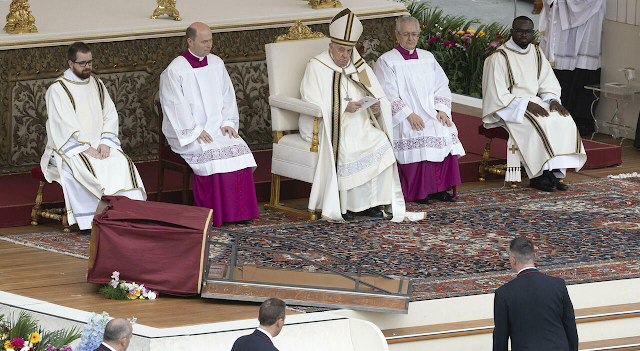
Finally, the fake archaeologist feature favored by Archbishop Piero Marini in the beginning of Pope Benedict's pontificate - the pseudo-ancient pallium - is to be retired. A new papal pallium (pictured above and very similar to the one used for most of the past centuries, up to Pope John Paul II) is to be used for the first time in the celebrations for Saints Peter and Paul.

This is the main point of the interview granted by the Master of Papal Liturgical Ceremonies, Monsignor Guido Marini, to L'Osservatore Romano (permanent link) which also includes some very interesting answers, especially on the mode of distribution of Holy Communion:
...
In the recent visit to Santa Maria di Leuca and Brindisi, the Pope has distributed communion to the kneeling faithful in the mouth. Is it a practice destined to become usual in papal celebrations?

I think so. Regarding it, it should not be forgotten that the distribution of communion in the hand still remains, from a juridical viewpoint, an indult from the universal law, granted by the Holy See to those Episcopal Conferences which have made a request for it. The mode adopted by Benedict XVI tends to underline the force of the norm valid for the entire Church. In addition, a preference could perhaps be seen for the use of this mode of distribution, which, without eliminating anything from the other, puts into light better the truth of the real presence in the Eucharist, aids the devotion of the faithful, introduces with greater ease the sense of mystery. Aspects which, in our age, pastorally speaking, it is urgent to underline and recover.

...

Still today the motu proprio Summorum Pontificum, on the use of the Roman Liturgy from before the reform effected in 1970, seems to give rise to contrasting interpretations. Celebrations presided by the Pope according to the extraordinary form, that is, the ancient one, are predictable?

It is a question which I do not know how to answer. Regarding the mentioned motu proprio, considering it with serene attention and without ideological views, together with the letter addressed by the Pope to the Bishops of the whole world to present it, a double precise understanding is brought forth. First of all, that of favoring the accomplishment of "a reconciliation in the interior of the Church"; and, in this sense, as it has been said, the motu proprio is a most beautiful act of love for the unity of the Church. In second place - and that is a datum not to be forgotten - its purpose is to favor a reciprocal enrichment between both forms of the Roman Rite: in such a way, for example, that in the celebrations according to the Missal of Paul VI (which is the ordinary form of the Roman Rite) "will be able to demonstrate more powerfully than has been the case hitherto, the sacrality which attracts many people to the former usage".

Labels:

For the Record

...those conditions are not proposed to the Lefebvrists [sic] in general, but actually to their Superior, that is, Fellay himself. Who, in the discussions, displays a will to dialogue, but afterwards writes and undersigns very harsh attacks against the Pope. The five conditions are thus a prior step before reaching the cancellation of the excommunication. [...]
(2) Paolo Luigi Rodari on calls to the headquarters of the Priestly Fraternity of Saint Pius X (FSSPX / SSPX):
[...]
A very small indication regarding the fact that, probably, the Lefebvrists [sic] will accept the conditions proposed by the Holy See (or that they are at least seriously thinking about them) came to me by way of a phone call I made yesterday to Ecône, headquarters of the Fraternity of Saint Pius X. As in other occasions in the past, I asked to speak with Bishop Fellay, the Superior of the Fraternity. In the past, particularly when he wished to respond that there was no news regarding their re-entry in the Church, he answered me quickly. Yesterday, instead, he made it known that there was nothing to say. Perhaps because he is seriously thinking about accepting the Vatican conditions but does wish to say so?

Labels:

Tuesday, June 24, 2008

Decision 2008: The Conditions
Update: The actual Document


_______________________
Pontificia Commissio
"Ecclesia Dei"
Conditions which result from the meeting of June 4, 2008,
between Cardinal Darío
Castrillón Hoyos and Bishop Bernard Fellay

1. The commitment to a response proportionate to the generosity of the Pope.
2. The commitment to avoid every public intervention which does not respect the person of the Holy Father and which may be negative to ecclesial charity.
3. The commitment to avoid the claim to a Magisterium superior to the Holy Father and to not propose the Fraternity in contraposition to the Church.
4. The commitment to display the will to act honestly in full ecclesial charity and in respect for the authority of the Vicar of Christ.
5. The commitment to respect the date - fixed for the end of the month of June [2008] - to respond positively. This shall be a condition necessary and required as an immediate preparation for adhesion to accomplish full communion.

[Signed] Darío Card. Castrillón Hoyos

Rome, June 4, 2008
_______________________
[Update - 1700 GMT]
-French original text (permanent link) of the document signed by Cardinal Castrillón Hoyos after his meeting with the Superior General of the Priestly Fraternity of Saint Pius X (FSSPX / SSPX).
-Italian translation: Andrea Tornielli.
-As a measure of comparison, it might be useful to recall the five conditions agreed between Archbishop Marcel Lefebvre and Cardinal Joseph Ratzinger twenty years ago (part I of the Protocol of May 5, 1988).

Labels:

Patriarch of Constantinople:
Homily, Creed, and Blessing together with the Pope


Holy Mass of Saints Peter and Paul, Apostles, presided by the Holy Father Benedict XVI, with the participation of Ecumenical Patriarch Bartholomew I

On Sunday, June 29, 2008, Solemnity of Saints Peter and Paul, Apostles, the Holy Father Benedict XVI will celebrate the Eucharist, at 9:30, in the Vatican Basilica, with the participation of Ecumenical Patriarch Bartholomew I.

The Ecumenical Patriarch and the Holy Father will deliver the Homily, jointly recite the profession of faith [Creed], and impart the blessing.

The new Metropolitan Archbishops, on whom the Pontiff will impose the holy Pallium taken from the Confessio of the Apostle Peter, will concelebrate with the Holy Father.

What Creed will be used? Without the Filioque - as in Dominus Iesus, 1?

Monday, June 23, 2008

Important: What Fellay said about the ultimatum
UPDATED


[Update - June 24, 0900 GMT] The Superior General of the Priestly Fraternity of Saint Pius X (FSSPX / SSPX), Bishop Bernard Fellay, spoke of the "ultimatum" in his sermon during the Mass of Ordinations in Winona, Minnesota, last Friday (June 20):

[33:12] Certainly, my dear brethren, you expect from me today also a certain update of how things are going with Rome. All these excommunications, or the lifting, or the retraction of the decrees of excommunication, is it coming or not? Frankly, I don't know. My impression, right now, is that we still can wait for a while, and maybe a good while. And why so?

Because the approach we have towards the question is not the same as the one of the Vatican. And I say this problem, always these words, they were the words of the Archbishop at the time of the bishops' consecrations twenty years ago. He said, 'Rome wants a reconciliation, but with these words, they intend, they want to say that we go back to the new', which is not to go back, but go in. And that's not what we want. He said the perspective is different, they speak of reconciliation, but it is an integration to the new. And we don't want that.

In '75, '76, it was already the same problem. Before the suspension of '76, Rome sent an ambassador to the Archbishop who told him, 'Say with me one New Mass, concelebrate with me one Mass, and everything is fine'. And now, well, they don't say 'Say one Mass', they just say 'Shut up'.

It is so far that Rome has given me an ultimatum. Seems that the last Letter to the Benefactors has been not so well received in Rome. They consider it as a proof of pride, of arrogance, and that's what they don't want. And we are not going to shut down our mouths, or to shut up.
[...]

[45:08] And now, we are, should we say, something like at a crossroads. And in a certain way, Rome is telling us, 'OK, we are ready to lift up the excommunication, but you cannot continue this way"

So, we have no choice, we are not going this way, we are continuing what we have done, we have fought now for forty years to keep this faith alive. To keep this Tradition not only for ourselves, but for the Church. And we are just going to continue, happens what happens. Everything is in God's hands. If God wants this proof, this trial to continue, it may continue. He will give us the grace we need for it. No fear, we'll wait for better times. That's what the Archbishop said twenty years ago. That's what we continue to say today.

Of course we have to do all what we can to have this faith to be continued, to be preached everywhere, this faith to be really, and all this Tradition to be really back in the Church. We have to do whatever we can for this, but nothing else. It is a hard time, my dear brethren, but it is not ourselves who are going to change it. We are in these circumstances, we did not cause them. So we depend on God.
__________________________________________

[Original post:] Father Adam Portugal, SSPX, mentioned Sunday in his sermon for the Sixth Sunday after Pentecost (St. Michael the Archangel Chapel, Farmingville, Long Island, New York) some important information which confirms what Andrea Tornielli published this Monday, relating to the faithful what had been said by the Superior-General of the Priestly Fraternity of Saint Pius X ( FSSPX/ SSPX) in his conversations with the priests of the United States District after the ordinations which took place last week, in Winona, Minnesota.

Father Portugal's words also reveal the mood of the SSPX leadership.

We have transcribed the most relevant passages of the sermon regarding this matter:

[1:11] Apparently, with regards to Rome. He mentioned it publicly, so I think it's fitting to mention it publicly, since you were not there, and to put an end to people flapping their mouth making gossiping sessions. His Excellency, Bishop Bernard Fellay, is not very pleased with that, very upset. He's very disappointed that people would lie like that. Especially the Sedevacantists, that are causing trouble, as usual, flapping their mouth and accusing him of wanting to be a cardinal, and wanting basically to sell his soul and the SSPX, all kinds of statements going around. It's hideous, really.
[...]

[2:04] At any rate, Rome apparently has set an ultimatum, it's what he said, for the end of this month of June, it's what he said. He does not know what that means, what the ultimatum means, what will happen, but that was what he said, and, basically, and he mentioned at the dinner, it was not in the sermon, he brought it up in the dinner, that the, uh, the points...[sic] He got a fax from Cardinal Castrillon Hoyos in French stating some four or five points, basically of what Rome expects from the Society of Saint Pius X. Basically, of course, you know, sign, sign up [...], right? But basically it's 'be quiet'. 'Fine, you can say the Latin Mass, fine you'll be recognized'.

At least, you know, in the 1970s they wanted Archbishop Marcel Lefebvre to say the New Mass once. It's no longer a question anymore. But, the problem has changed. At least, uh, it's become, it's the same problem, it hasn't changed, what I mean is, insofar as their condition now is they don't want us, basically, as he said, they want us to be silent, they don't want us to speak of, let's say, let's not rock the boat, basically, regarding Vatican Council and the New Mass. So to put it in a nutshell, that's it.

[...]

[4:53] At any rate, so, Rome has made this known, public, His Excellency made it a public concern to everyone at Wino...[sic], at the ordinations, so. But, to reassure the faithful, that's all, to simply reassure the faithful that we carry on, and if Rome wants to punish us for that, well, hey, I'm sorry, what is our crime? For a punishment, there must be a crime.

Labels:

Tornielli: SSPX-Rome Agreement near
Updated: Offer confirmed by the SSPX

URGENT: Vaticanist Andrea Tornielli reports today in Il Giornale that an agreement of the Holy See with the Priestly Fraternity of Saint Pius X (FSSPX / SSPX) may be very near. Some days ago, the Superior General of the Fraternity, Bishop Bernard Fellay, met with the President of the Pontifical Commission "Ecclesia Dei" and, before June 28, the Fraternity should decide to accept the five conditions proposed by Rome.

Translation to follow soon (Italian text).
[Update: 1500 GMT - Translation:]


n. 25 of 2008-06-23 page18

The Ultimatum of the Vatican to Lefebvre's rebels: peace, if you accept the Council

by Andrea Tornielli

In exchange, they will receive a Prelature. But they must choose before June 28.

ROME -In the relations between the Holy See and the Lefebvrians the countdown has begun: by this 28 June, the Fraternity of St. Pius X, founded by the French Archbishop who would not suffer the post-conciliar liturgical reform, will in fact have to decide whether to accept the five conditions proposed by the Vatican in order to reenter into full communion with Rome. Some days ago, the superior of the Lefebvrians, Bishop Bernard Fellay, met with Cardinal Darío Castrillón Hoyos, president of the Commission Ecclesia Dei, which deals on behalf of Benedict XVI with negotiations with the traditionalist group. Fellay, who previously had written to the Pope asking for the revocation of the excommunication imposed by John Paul II in 1988 to Lefebvre and the four new bishops that he had wanted to consecrate without the consent of the Holy See (among them Fellay himself), has received a letter with the five points set by the cardinal [Castrillón] and will discuss them during the next chapter of the fraternity, to be held at the end of the month.

Never like at this moment the negotiations have come close to an agreementwhich would heal the mini-schism which had been created now two decades ago, allowing the full reentering of the Lefebvrians into the Catholic communion. Among the points that the Holy See asked to sign there would be, according to the indiscretions gathered, the acceptance of the II Vatican Council and the declaration of full validity of the Mass according to the reformed liturgy: two conditions that Lefebvre had already signed with the then cardinal Joseph Ratzinger in 1988. The Vatican, for its part, offers the traditionalist group a canonical framework similar to that of Opus Dei, namely a [personal] "prelature", which would allow the Fraternity to continue its activities and to train its seminarians.

The march of rapprochement was started in 2000, when the Lefebvrians made a Holy Year pilgrimage to Rome. It was followed by a brief audience granted by Pope Wojtyla to Monsignor Fellay and the beginning of the long and laborious negotiations with Cardinal Castrillón. Many things have changed since then however. The Lefebvrians asked, before making any step towards an agreement, that the old preconciliar missal, which fell into disuse after the liturgical reform, be liberalised. The new pope, Benedict XVI, particularly sensitive to these issues, a year ago published the Motu proprio declaring the full citizenship of the old Mass allowing it in every parish, in fact stripping the bishop of the possibility of prohibiting it. The application of the new papal directives has not been easy, there are a lot of cases of resistance - some blatant, as is known - but it is beyond doubt that by declaring the existence of an extraordinary Roman rite (the old one) and an ordinary (the reformed one), the Pope has authorized throughout the Church and without restrictions the celebration of the Tridentine Mass. Moreover, Ratzinger has reintroduced the Cross at the centre of the altar, has begun to distribute communion to the faithful kneeling, has restored ancient vestments: all signals that go in the direction of emphasizing the continuity of tradition.

Conditions this favourable for a reentering into full communion will in all likelihood not repeat themselves. Many faithful, now that they have obtained the Mass according to the ancient rite, do not understand why the Fraternity does not definitively make peace with Rome. The Lefebvrians have come to realize what is happening, even if Fellay has some problems of internal resistance. The choice is whether to make an agreement and reenter into full communion with the Holy See, or rather to remain a small separate body with the risk of turning into a little sectarian and uninfluential group.

(Translated by Gregor Kollmorgen, for The New Liturgical Movement). [ITALIAN ORIGINAL]

_______________________

[Update: 1800 GMT] Roman-based news agency I.Media and Swiss news agency Apic report that the SSPX has confirmed the Roman offer:

The Holy See, contacted by the news agency I.MEDIA, has neither confirmed not denied this information [reported by Tornielli]. It confirmed to it, however, that Bishop Bernard Fellay, Superior of the Priestly Fraternity of Saint Pius X had indeed made a visit to Rome a few weeks ago.
...
Asked Monday by [Swiss news agency] Apic, Father Alain-Marc Nély, second assistant of Bishop Bernard Fellay, Superior of the Priestly Fraternity of Saint Pius X at Menzingen (Canton of Zug), has completely confirmed the existence of proposals by the Vatican.


Unwilling to enter in the wider details, Father Nély has nonetheless confirmed that an agreement proposal has been made at the beginning of the month. With conditions. The answer will be given from now up to June 28, "God willing", and will then be made public, he explained. The number three of the schismatic [sic] community has not wished to indicate what direction Bishop Fellay's response would take.
(Source: Apic/Permanent link)

Labels:

Sunday, June 22, 2008

Help and suggestions

We would like your opinions and suggestions regarding the following question sent by a dear reader in the Southern United States:

How can traditional Catholic communities most effectively advertise special events such as Solemn High Masses? What have other communities done to ensure the success of their Solemn High Masses?
We would also add:

Have any of you been successful in increasing the number of regular assistants at a regularly scheduled Sunday Low Mass? What measures of advertising are deemed respectful and effective?
Please, write on. If you do not wish to have your answers or suggestions published, send them by e-mail to newcatholic AT gmail DOT com. Thank you.

Saturday, June 21, 2008

Vos esurientes accipite


And He asked them: how many loaves have ye? Who said: Seven. And He commanded the people to sit down on the ground. And taking the seven loaves, giving thanks, He broke and gave to His disciples to set before the people. And they had a few little fishes, and He blessed them, and commanded them to be set before them. And they did eat, and were filled: and they took up that which was left of the fragments, seven baskets: and they that had eaten, were about four thousand: and He sent them away. (From the Gospel for the Sixth Sunday after Pentecost, Saint Mark viii, 1-9)

In expounding to you the Holy Scriptures, I am, as it were, breaking bread for you. You in hunger, do receive it (Vos esurientes accipite), and break forth with a fullness of praise from the heart; and you who are rich in your banquet, be not meager in good works and deeds. What I deal out to you is not mine own. What you eat, I eat; what you live upon, I live upon. We have in heaven a common store-house; for from thence comes the Word of God.

The "seven loaves" signify the seven-fold operation of the Holy Spirit; the "four thousand men," the Church established on the four Gospels; "the seven baskets of fragments," the perfection of the Church. For by this number very constantly is perfection figured. For whence is that which is said, "seven times in a day will I praise thee"? Does a man sin who does not praise the Lord so often? What then is "seven times will I praise," if not that "I will never cease from praise"? For he who says "seven times," signifies all time. Whence in this world there are continual revolutions of seven days. What then is "seven times in a day will I praise Thee," but what is said in another place, "His praise shall always be in my mouth"?

With reference to this perfection, John writes to seven Churches. The Apocalypse is a book of Saint John the Evangelist; and he writes "to seven Churches." Be hungered; own these baskets. For those fragments were not l